
CORPORATE HEALTH: A WAY TO PAVE A HEALTHY WORKPLACE
Corporate health has evolved over the years, mirroring shifts in our understanding of health within the workplace. Historically, employee health was often overlooked, as employers primarily prioritized productivity. In recent years, corporate health management has taken on a more holistic approach, seamlessly integrating wellness programs with broader health management strategies, encompassing both physical and mental well-being. Numerous market studies and research have been conducted to demonstrate the beneficial outcomes associated with the implementation of effective corporate health management programs. It's evident that involving employees in corporate health programs can contribute to an organization's success by boosting job satisfaction and fostering a more dedicated workforce. In the wake of the COVID-19 pandemic, the exploration of innovative methods to maintain employee engagement in corporate wellness programs is now more critical than ever.
CORPORATE HEALTH: WHERE IS IT HEADING?
According to the World Health Organization, stress, anxiety, and depression are projected to become the leading causes of disability in the next 20 years. In October 2022, United States Surgeon General Vivek Murthy released guidelines aimed at promoting employee mental health in the workplace. Given the increasing concern about mental health, there is a growing demand for stress management and overall mental well-being. Consequently, various wellness programs have been introduced to address this emerging need for corporate health within the workplace.
The landscape of workplace mental health has undergone substantial changes over the past four years, with acceleration due to the global pandemic. On one hand, mental health is under greater strain, influenced by social, economic, and geopolitical factors. On the other hand, there is a growing collective awareness of the significance of mental health. As the world emerges from the pandemic, employees are reevaluating their priorities. Meanwhile, companies face the challenging task of maintaining a healthy workforce while ensuring a sustainable return on investment and productivity. Today, large organizations invest an average of over $10 million per year in corporate health management, placing considerable financial and administrative pressure on companies already contending with the demanding global business environment.
The 2023 Employee Wellness Industry Trend Report indicates that nearly 50% of companies plan to reduce their investments in corporate health. Nevertheless, the global corporate wellness market's value exceeded $60 billion, and it is anticipated to reach $100 billion by 2028. This raises the important question: where is the trajectory of corporate health heading? Does fostering a healthy workforce and a harmonized workplace genuinely necessitate such substantial investments?
THINK AGAIN: WHAT KEEPS US ALIVE AND WHAT MAKES US HEALTHY?
Life follows an orderly pattern of matter, and all living organisms maintain their internal order by extracting free energy from their surroundings. Entropy, a measure of disorder, continually increases in a living organism like our body as it undergoes biological processes and physical activities over time. To counteract this natural increase in entropy and the aging process, we engage in activities such as breathing oxygen, consuming food, and doing physical exercises. Paradoxically, the more we engage in these activities, the faster entropy accumulates. This phenomenon underscores the duality of life and death. Activities like exercise, running, and active thinking raise our heart rate and generate more entropy.

Hence, there is a saying that each of us is given approximately 2.5 billion heartbeats in our lifetime. The quicker we expend them, the faster we accumulate entropy, which drives us faster to the end of our lives. Consequently, it becomes clear that exercise can improve physical condition but does not necessarily lead to longevity.
Let's now explore the consequences of physical exercise. Engaging in activities like running or gym workouts necessitates the pumping of sugar to fuel our muscles, which, in turn, requires an increased production of insulin. During this process, there is a redistribution of energy, with more energy becoming available for the extremities and less for the trunk of our bodies. Vital organs reside in the trunk, and they can be subject to energy deprivation. An illustrative example is the Greek soldier who, historically, died at the finish line of a marathon due to kidney failure. While many people strive to shed belly fat through exercise, it is important to note that approximately 80% of fat is eliminated from our bodies through breathing. If these simple facts aren't convincing, one need only glance at the state of public health in the real world. The war on cholesterol and the promotion of healthy lifestyles have been ongoing for decades. One might expect that we should be living in an exceptionally healthy world, yet the reality is quite the opposite. We are bombarded with the pandemic of obesity, diabetes, fatty liver, cancer, mental illness, and a growing list of health issues.
Ancient practices such as yoga, Chi Gong, Tai Chi, and Taoism all share a fundamental focus on breathing. Today, with the advancement of scientific knowledge, we have gained a better understanding of the mechanics of breathing and its role in sustaining life and consciousness. As early as 1733, Stephen Hales observed the correlation between heartbeats and respiration. Over the years, many scientists have explored the impacts of respiration on the heart and brain. In 1938, Dr. Corneille Heymans was awarded a Nobel Prize for discovering the oxygen-sensing mechanism of the carotid body, which communicates directly with the brain to control breathing. By 2019, it was discovered that all cells and tissues possess oxygen-sensing abilities, thanks to the contributions of three Nobel Laureates. Despite this renewed scientific exploration, we are still far from fully comprehending the true essence of breathing. Nevertheless, one aspect remains evident: effective breathing serves as a bridge between the mind and body, enabling a coherent state. In this state, we consume less energy, and our bodies operate more efficiently with all electrophysiological processes. Hence, in the context of health or corporate health, breathing emerges as the primary factor to be taken into account.
CORPORATE HEALTH IN THE WORKPLACE
Research conducted by the Principal Financial Well-Being Index has revealed that 45% of workers found encouragement to work harder and perform better through their participation in corporate health programs. It is undeniable that effective corporate health programs can contribute to the development of a robust workforce and a positive corporate culture. However, there is a persistent dilemma that confronts both employers and employees.
A successful corporate health management program demands not only a significant financial investment but also substantial organizational and administrative commitments. Often, these programs are held off-site and outside of regular working hours, making it challenging for management to stay closely involved in their operations. For employees, participating in such programs necessitates an additional allocation of their personal or office time. Regrettably, time is a limited resource, especially for those who bear family responsibilities or endure lengthy commutes to work. The situation becomes even more discouraging when employees face a heavy workload and tight time pressures, as it is precisely during such times that participation in corporate health programs becomes all the more crucial but equally unfeasible.
The aforementioned challenges represent just a fraction of the issues encountered by corporate health programs. Another pressing concern relates to how corporate health management can provide assistance to employees grappling with mounting mental and physical pressures in the workplace. Conventional corporate health programs are primarily designed to enhance mental and physical resilience in order to cope with workplace stress. Yet, there is little to offer at the very moment of experiencing a stressful workload at the workplace. This unmet need within corporate health programs is a critical aspect that requires attention and improvement.
AN OPTIMAL CHOICE FOR CORPORATE HEALTH WITH AIRNERGY
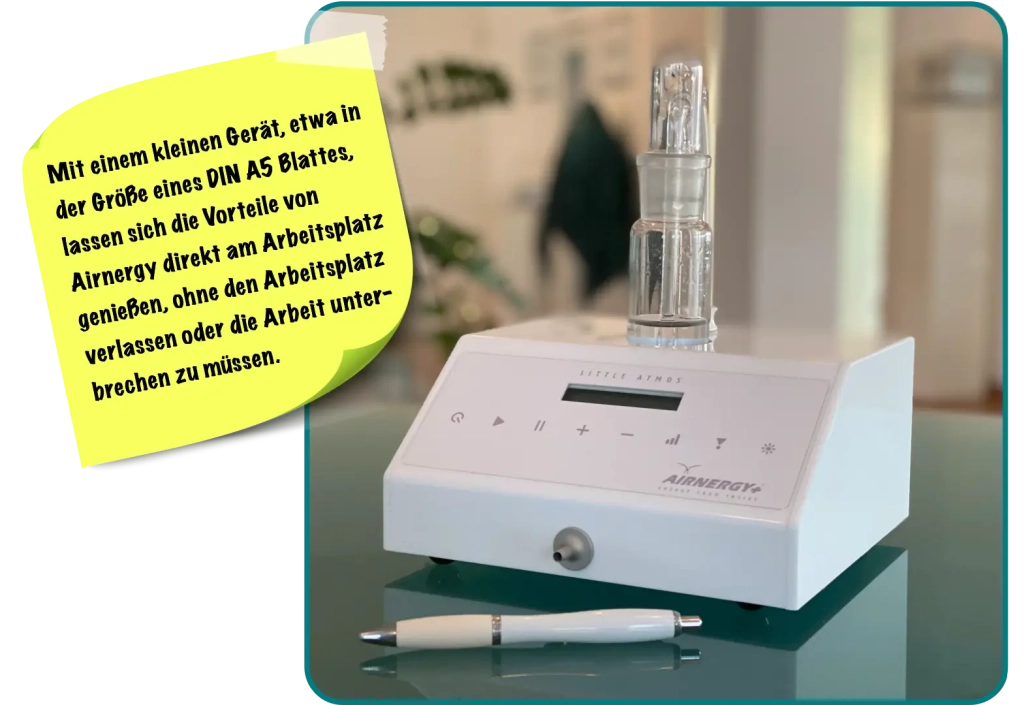 If we classify work-related health issues, they typically fall into two categories: mental and physical. These two aspects are interconnected, with one influencing the other. As breathing serves as the bridge between the mind and body, Airnergy operates on this interconnection, contributing to holistic well-being.
The most pivotal attribute of Airnergy breathing lies in what it ultimately introduces into our bodies. Under normal circumstances, we breathe ambient air, which comprises a mixture of oxygen along with various gases, dust, electromagnetic radiation, and particles, including PM 2.5. Not only can these harmful particles cause damage to our bodies, but oxygen itself can lead to the generation of Reactive Oxygen Species (ROS) as a byproduct of energy transfer. Moreover, about two-thirds of the inhaled oxygen is exhaled back into the air when we breathe out.
Airnergy transforms this paradigm. Initially, it filters out harmful dust and PM 2.5 particles, after which it activates the energy transfer process of oxygen within the device, akin to how plants convert sunlight through photosynthesis. The energy generated is immediately captured by water in the sparking element. Consequently, when you breathe using Airnergy, you intake pure green energy and clean air. This process alone leads to increased oxygen absorption in the bloodstream, as demonstrated in scientific studies. In comparison to breathing high-concentration oxygen, Airnergy showed an increased peak flow of oxygen levels, whereas high-concentration oxygen resulted in a reduced peak flow of oxygen levels. Additionally, Airnergy breathing led to less exhaled oxygen, a significant reduction in heart rate, and a decrease in breathing rate. These phenomena play a pivotal role in a cascade of health benefits:
- Reducing oxidative stress, mental stress, and anxiety while promoting mental calmness. This results in improved focus and enhanced mental capacity and concentration, crucial for the mental well-being of workers in the corporate environment.
- Enhancing autonomic and cardiac functions, which rejuvenates both the mind and body with the required energy for improved work performance. It is especially effective against mental disorders and tension, the most significant problem in corporate health. Strengthening the immune system and antioxidant capacity is key to combating various health issues and conditions.
- Optimizing cellular activities and promoting aerobic cellular respiration, is essential for metabolism, weight control, and the regulation of cholesterol and blood sugar levels.
- Fostering the self-healing capabilities of the body is a crucial factor for genuine well-being.

The holistic health benefits of Airnergy have been substantiated through its role in combating oxidative stress, inflammation, and aging while boosting energy levels. Moreover, it has gained recognition and use by professional health management organizations, healthcare providers, and professional sports teams, including Olympic teams.
THE BOTTOM LINE – CHANGE CORPORATE HEALTH STARTING WITH AIRNERGY
Corporate health is an increasingly prominent trend on a global scale, given the evolving business landscape and the nuanced relationships between employers and employees. Airnergy stands out as an ideal tool for any corporate health program for several compelling reasons:
-
It offers a high return on investment and can cater to multiple individuals on a single system.
-
It's considered a corporate asset, making it potentially beneficial for corporate taxation purposes.
-
Airnergy requires no elaborate setup, occupies minimal space, and can be effortlessly relocated within the workplace.
-
Employees have access to the smallest spa in the world, right at their desks, precisely when they need it most.
-
It doesn't demand extra time from employees and addresses both mental and physical health concerns at their roots.
-
Airnergy seamlessly integrates with existing corporate health programs or can serve as an independent solution, a valuable flexibility, especially for resource-constrained small to medium-sized companies.
It is particularly well-suited for specialized occupations that demand a high level of competence and mental capacity in the workplace. Examples include but are not limited to aviation, night shift professions, medical care and rehabilitation providers, the hospitality industry, and the military.
In essence, life begins with a breath and concludes with a breath. Simultaneously, water serves as the cradle and foundation of life. Our cellular inspiration is the process of producing a solitary water molecule, the true green energy of life, from the combination of oxygen and sugar. This is precisely what Airnergy accomplishes — it transcends the limitations of human physiology, delivering readily available green energy through breathing to enhance individuals' health. In return, it provides companies with an outstanding return on their investment.


Awards and prices
The Airnergy company received several awards and prizes for its advanced developments. Among other things, the only one time awarded for innovation, an innovation prize that praised the Airnergy method in particular as the most holistic regeneration source of the past 100 years, the

Would you first like to find out what spirovitalization with Airnergy can do for you?
Your own experience is important
Would you like to try out what Airnergy can do for you? Here you will find a selection of different facilities throughout Germany and in other countries where you can experience "vitalization with Airnergy". Energy cures with 10 to 20 treatments of 21 minutes each have proven to be a good way of getting to know Airnergy and achieving lasting vitalization/detox effects. |use for|optimiseYour own energy station
Would you like to be using your own energy station at any time?Whether for use as a commercial service, for subsidised company health care (BGM) in the company or for you and your family at home, simply ask about the leasing, subsidy* and financing conditions.
We will be happy to support you! |Leasing | Financing